Saturday, 18 February 2012

Making Tracks


Sometimes amazing learning opportunities occur when you least expect it to happen.  It is only the second week of the year with our new group of 3 year old children.  For many of them it is the first time they have been away from their parents, let alone in a play situation with 19 other children, in an environment they are unsure of.


 It began with a child (A) using a truck roller on the edge of the sandpit.  He then stood back to admire the path he had made.  This drew the attention of another child (B) who had been watching the roller out of the corner of his eye.  I could see B really wanted to use the roller and was waiting patiently for his turn, I approached B and initiated a conversation which lead to the two of us looking for other equipment they could use as a roller.


 We returned with a cardboard tube.  I could see B was using all of his resilience skills to accept the new prop. He made several comments about it not being the same and being to big, so we went exploring again.  This time joined by several other children.


Finding smaller plastic items that were still covered in the previous evenings dew, we returned to the sandpit and began our rolling. 
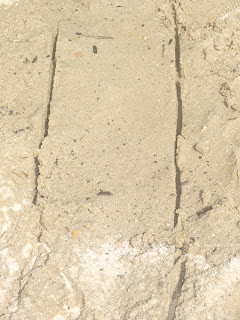
As the children applied the items various patterns then appeared lightly in the sand.  This was pointed out to the children who became quite excited and then began using several others types of rollers to make more tracks.

One of the children voiced his frustrations when his tracks disappeared as he walked over them.


I reflected on how I could support this experience further, and enhance their learning without taking over. With the intention of making the sand a little more stable so the tracks would become more visible, I added a watering can, full of water, to the sandpit.  The children began rolling over the wet sand and excitedly looked back at the marks made "That's like a train's track" said C,   "No, more like a road, see this is the line in the middle"  said B,  as he noticed that two rollers had been used together, leaving a very unique impression in the sand.

The children used the watering can to add even more water to the sandpit and see what various tracks they could create.


 When all the watering cans were being used child D decided to take his roller to the water source, to wash the sand off and bring back drips of water.

Throughout this learning opportunity I  discussed simple mathematical concepts with the children, such as - counting, depth and volume as further opportunities arose.  The children in turn explored these concepts, pushing their rollers deeper into the sand, measuring the length and width of tracks with their hands or feet.

A small group then experimented with the rollers on the grass areas and footpaths but returned to the sand stating the tracks were easier to see.


Friday, 3 February 2012

Music Wall

I was inspired after reading several posts from Jenny from (http://progressiveearlychildhoodeducation.blogspot.com.au/2011/05/ideas-for-music-play-outdoors.html) discussing music and sharing beautiful images of music walls that were so simple yet so creative and inviting.


A quick visit to Resource Rescue and I returned to the service with metal cans, lids, rope and drum sticks. I showed the children the images of music wall and we discussed where the best position in our yard would be to construct one.


We then set about hammering holes in the tins and threading the rope through and securing the tins to the fence.  The children noticed a frying pan in one of the photos so we gathered up ours from the sandpit and a metal jug along with bells.


It was a very popular play station throughout the year.  When the wind blew the tins would rattle and often re-engage the children.

This was a very simple, and inexpensive way to extend on the children's musical interests and creativity.


Saturday, 28 January 2012

Creating a rock wall

Building a rock wall takes a great deal of patience, concentration, spacial awareness, mathematics and trial & error.


Child R (4yrs) was overheard expressing a concern to his peers about the amount of sand that was running into the pond through a gap in the rocks that surround the sandpit.

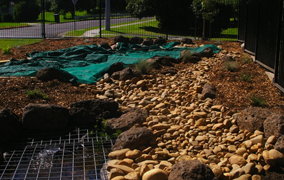
The educator was called away to support another area of play and when she returned roughly 10minutes later child R was observed in the dry creek bed collecting rocks and carrying them back to the gap.  Child R then began sorting        and classifying the rocks into size and shape before laying a row down.

When the first row had been laid, child R collected more rocks and returned to lay another row on top.  Again he sorted the rocks, however this row was proving a little more difficult as rocks needed to balance on top of each other.  The wall fell several times, but child R persevered, calling out for peers to get smaller rocks or bigger rocks from the dry creek bed.


 Once completed, child R showed an enormous amount of pride in his work, explaining to the educator how some of the rocks kept falling "but I just kept trying like a jigsaw".  He then asked if the wall could stay up so he could show his mum when she collected him.


This was one of my favourite experiences to observe last year.  Completely child initiated and carried out.  Child R demonstrated many skills through this project including an appreciation and respect for his environment, classification skills, mathematical concepts and wonderful
                                                                                    communication skills.


Thursday, 19 January 2012

Identity and belonging

Identity and feeling like we belong are such an important aspect of our personal development.  Research shows that children who have trouble understanding their identity and forming secure attachments have difficulty thriving academically.

Maslow discussed this principle at length and documented it in his hierarchy of needs.  Knowing who we are and where we belong is fundamental to life-long learning and success both personally and professionally.  Early Years Educators have been feverishly learning about how we can support children within our services understand who they are and how they belong, to ensure the best outcomes for the child and meet legislative requirements.

I was blessed to be able to observe two of the 4 year old boys in our ELC, as they attempted to uncover what makes you belong to a family.

It began through a simple conversation at the easel.  J and R were discussing what they were painting.  J decided to paint his family, "Good idea" replied R and began painting his.  Both children kept checking in on the others painting, comparing similarities and differences in their artwork.  "Why do you have two girls in your family?" J asked R.  "UMMMM, that's my mum and my sister" R replied walking around to look at J's picture.  "Ummmm, your missing a sister on yours" R proclaimed.  "No, I don't have a sister, doesn't matter girls are silly anyway" J said.  R paused for a minute "who is them?" "That's my big brother and my little brother" said J.  Again R paused for a while, "Hey wouldn't it be cool if we were brothers!" he said  (These two have been very close friends all year) After a few excited laughs and 'high 5s' R looked at J "It wont work, your skin is a different colour to mine" he said "We can't be brothers, cause they have to be the same"

'Was this an intentional teaching moment??? Should I step in and discuss how families are different and unique, pointing out posters around the room and looking at our family photo albums with the children?  I could, I could, my mind was going crazy with all of the ways I could extend their knowledge, broaden their thinking and concepts.  Instead I stood back and waited to see what the two boys would do.'.......

"Just because our skin is different..... you know we are still friends" J said, and held R's hand.  Just then the two noticed they had brown flecks of paint on both their hands from their artwork. "Hey they look like freckles...... we both have paint freckles........brothers have freckles"  With that J pulled R closer to the easel. The two began mumbling to each other and both stood back from the easel at the same time holding a paint brush and began painting their arms.


Curious, I asked what they were doing.  "Just making sure we can be brothers" J said casually.  "yeah we have to look the same to trick our mums" R replied laughing

This one single child initiated experience sparked a great deal of discussion about families and how we look, amongst the group for the next few days, allowing plenty of opportunity for intentional teaching moments.

Discussing Risk

During a class last year discussing the importance of children taking risks in play to further support their development and independence, I was asked by a student "How I supervise children's 'risky play', what happens if the children hurt themselves?,  and how do you impose limits to ensure their safety?"

It took me a while to respond.  I had never consciously taken the time to reflect on the how's and why's, it just seemed to evolve, I understood the children's capabilities and trusted them and they in turn trusted me if I asked a question of their play or made a 'safety suggestion'.  I had difficulty with the term 'imposing limits'. Why should I impact on the learning if the risk is calculated and the children are safe?  I guess I was picturing a carer walking around the yard barking orders or nagging "Put that back.  That's not safe, or STOOOOOP!"

So I began to reflect on how we ensure the children's safety while creating an environment rich in learning, play and risk.

Throughout the year we discussed incidentally and purposefully with children the importance of their making safe choices in play, keeping our friends safe and respecting the toys and equipment.  Educators take the time during play or while guiding behaviours to point out "What would happen if?",  ''What could we do to make it safer?" and "Is it a safe choice?" Quite often we could hear children asking each other 'Is that a safe choice?" They began to guide each other and learn to take calculated risks. Towards the latter part of the year the children even began explaining why they had chosen to use certain pieces of equipment, which I will illustrate later.

Of course a HUGE part of supervision in risk is knowing the children.  As an educator, knowing and understanding what the children can do and achieve both individually and in groups and the interplay within the groups.  Understanding that each child will have their own skill set and capabilities and be close to offer support, when and if needed.

Another important element is setting the playspace, allowing room for the children to evolve their ideas and concepts, having enough 'loose parts' available to support their extensions, ensuring you can still observe or better yet be part of the experience and allowing movement of the objects if needed.

A few weeks after the question from the student, I was invited to take part in a play experience that some of the 3 and 4 year old children were developing.

It began simply enough, one child (R) wanted to create a "wall to keep the other kids out cause they keep messing me up".  He invited a close peer (I) to help him. (I) followed (R) to the tyre and together they tried to lift and manoeuvre it.  Rain from previous days had settled in the tyre and weighed it down.  I could hear them heaving and hoeing, (R) looked up and (L) was watching the two. (R) said to (L) "you can help us make the wall if you want, but you need to be really really strong" (L) quickly joined the group and they negotiated the tyre up and onto its side, rolling it along the path and squealing in delight as the water began gushing out.  ( I can already hear some of you shocked - what, children move tyres themselves, that s not safe, what if they hurt themselves or somebody else)

I  had thought about this and as I said earlier I knew the capabilities of these three children both individually and working in groups.   I weighed up the 'risk' compared to the 'learning', already the children had demonstrated amazing social, team skills, communication and negotiation skills not to mention cognitive concepts.  I was eager to see where it would lead. After placing the first tyre down the trio ran off to source more tyres, sometimes wheeling them back individually, other times in pairs.  (L) chose to push a tyre by herself and lost control dropping the tyre with her finger underneath (yes there was an accident, albeit a very minor one) however rather than being upset (L) looked at the educator "That wasn't safe of me was it? I should have waited for the boys" called them over to help her and continued on her merry way.
When all of the tyres were in place, a discussion occurred between the three on the best way to position them. (R) wanted them leaning against the step (I) said "but that makes them to wobbly and I can't climb the wobbly ones" the group continued negotiations and had many ideas.  I asked if they needed some extra help and began talking through each idea with them.


(R) was persistent that he wanted the tyres "wobbly" so as a group we set them up as a trial. (I) quickly balanced on one "See (R) they are just not OK, too wobbly"  I observed (R) silent and watching as (I) tried to negotiate his way to the top. (R) supported his friend as he neared the top "Look (I) is nearly there he can do it."  (I) stumbled a little at the top and quickly jumped from the tyres "NAH, its too wobbly"  (L) attempted to climb the tyres and stumbled, slipping into the centre of the tyre, she quickly looked up at the boys "hey lets stack them" All three were in excited agreement and began negotiating the stacks. Working together and asking the educator for a little assistance to make sure the tyres were safe and wouldn't topple.

The three then set about climbing, jumping and exploring, practicing skills, observing each other to acquire new skills and gaining confidence as they mastered them.


I was delighted to share this experience with the students next time I taught them.  This helped to illustrate what we had been talking about all those weeks earlier.  It generated plenty of debate about safety and other educators not allowing it to happen at the centres the students worked in and I left them with this thought.  " If we are truly to say we are implementing a play based, child focused program in our centres, then we need to be prepared to facilitate play, not quash it before it has a chance to grow and develop.  The creativity and learning, both individual and as a collective that occurred for these children in the space of 40 minutes would never have happened had I told them that the tyres can only be used for one purpose, can't be moved by the children or worse still, have to stay in one place. What skills have they learnt that will support them through life?" 

How do you support children to take risks at your service?


Tuesday, 17 January 2012

New Years Resolution!


Did anyone else have trouble juggling the growing list of things that needed to be completed last year?
I know I sure did - hence the delay in blog posts.  I began this site so inspired and enthusiastic after following a number of blogs and feedback from many of the students at Coonara Community House, but as the year progressed I got caught up in the day-to-day tasks and stopped taking regular time to blog - which I find quite relaxing.

I have spent the last few days reflecting on 2011 - the year that was. Looking back through programs, learning stories and photographs of what we achieved in the ELC, the projects that we were able to take part in with the children, the opportunities to extend play and learning and the fun - you can't forget the fun.

I then realised I needed to make a resolution.  Taking into account how relaxing I find blogging my resolution will be to blog weekly, using it as an opportunity to incorporate reflective practice as well as sharing ideas with the blogging community.

I would love to hear your suggestions and strategies on how you make time to blog.
What tools do you use?


Tuesday, 13 September 2011

The great outdoors


Liz and I worked incredibly hard designing the playground that would suit the philosophy of the service, the needs of educators, families and children, while still meeting all regulations.

The following images are of the playground when it was completed in early Feb 2011.  We are still aiming for a larger planted area of lush green, and a natural shade space over the sandpit.  There are so many areas of the playground that I love, the mud pit, dry creek bed, veggie patch - but by far the most enjoyable is the grassy hill.  There is nothing better than sitting on top of the hill with the children and having snack, singing, reading or watching the clouds roll in over the nearby hills and discussing the weather, or watching the native Kookaburra in the tree.
Our Mud patch

This space has been used as a book area, home corner, block area, office
Sandpit, dry creek bed and frog pond


We sank the slide into the hill and have a fantastic texture fence
which has various natural fibers in sections


The fence also has a large piece of perspex for painting, shaving cream and mud play

Hi-lo logs and seats along with our vertical garden

The path winds its way through the playground, we used different stone types
to add colour and texture to the experience